Handwriting
St. Mary’s Primary School
Handwriting Policy
At St. Mary’s Primary School, we are very proud of our pupil’s handwriting and take particular care in our handwriting style. In line with the Writing Framework 2025, handwriting is taught explicitly and regularly across the school beginning in reception, in addition to writing in phonics lessons. We use Letter-join’s whole school handwriting scheme as the basis of our handwriting policy, which enables us to meet National Curriculum requirements through a structured teaching programme.
Objective
Handwriting is a basic skill that influences the quality of work throughout the curriculum. By the end of Key Stage 2, all pupils should have the ability to produce fluent, legible and, eventually, speedy joined-up handwriting, and to understand the different forms of handwriting used for different purposes.
Our intention is to make handwriting an automatic process that does not interfere with creative and mental thinking.
Aims:
- Develop neat, legible and speedy handwriting where letters and words are automatically produced in independent writing.
- Establish and maintain high expectations for the presentation of written work.
- Understand, by the end of Year 6, the importance of neat presentation and the need for different handwriting styles (joined, printed or capital letters) to help communicate meaning clearly.
Expectations
All teaching staff are encouraged to model the printed or cursive style of handwriting chosen for each year group in our school in all their handwriting, whether on whiteboards, displays or in pupils’ books.
Consistency throughout the school
Pupils should experience coherence and continuity in the learning and teaching of handwriting across all school years and be encouraged to take pride in the presentation of their work. Our objective is to help pupils enjoy learning and developing their handwriting with a sense of achievement and pride.
Handwriting frequency
Handwriting is a cross-curricular task and will be taken into consideration during all lessons. Formal teaching of handwriting will be carried out regularly and systematically to ensure Key Stage targets are met throughout learning, as emphasised in the 2025 Writing Framework..
Pens and pencils
Pupils will first learn to write with chunky crayons, chalk or soft pencils while developing a proper grip before exploring with large scale drawing and writing to build fine motor skills, then moving to smaller, more precise writing tools.
Inclusion
For children who experience handwriting difficulties due to fine motor development, including those who are left-handed and those with special educational needs, the appropriate additional support will be put into place. Letter-join’s Lesson Planners all include differentiation activities for extra practice/challenge and their Handwriting Recovery Programme is used as an intervention for our key stage 2 pupils to give structured support if they find handwriting challenging.
Key Stage Teaching
Early Years
For our youngest pupils we teach short handwriting lessons on a daily basis, which will include the following:
- warm-up activities to get ready for handwriting
- air writing, pattern making and physical activities to develop gross motor skills
- correct sitting position and pencil grip for writing
- mark making on paper, whiteboards, sensory trays and tablets, etc. to develop and refine fine motor skills
- the introduction of letter shapes, their sounds, formation and vocabulary
Lesson Planners
Module 1 Cursive: Early Years teaches handwriting using a printed font style.
This module is divided into three sections covering:
- pre-writing patterns
- easy letters and words
- harder letters and words.
At the end of this module children should be able to recognise and form all lowercase letters of the alphabet in a printed style.
Key Stage 1: Years 1 and 2
Teaching progresses from five short, to three longer lessons per week:
- continuing with gross and fine motor skills exercises
- strengthening handwriting, learning and practice
- numerals, capitals and printed letters; where and when to use, learning and practice
- KS1 SATs SPaG exercises
Module 2 Lesson Planners – Year 1
Module 2 Cursive teaches how to correctly use and write capital letters, printed letters, numbers, punctuation, maths symbols and other symbols. Children are then introduced to pre-writing patterns and cursive letters in preparation for Module 3 when they are required to start joining their handwriting.
This module is divided into three sections covering:
- warm-up activities, letter families and capital letters
- the uses of printed letters
- numbers and symbols
- the introduction of pre-cursive patterns and cursive letters.
On completion of this module, children should be confident in writing all capital and printed letters, numbers and symbols and have some familiarity with the orientation of cursive letters.
Module 3 Lesson Planners – Year 2
Module 3 Cursive: Year 2 introduces children to cursive letters and how to join them which is reinforced with regular practice in letter formation and joining.
The sections in this module cover:
- cursive letters and words
- revisiting letter families
- high frequency words
- joining techniques
- sequencing sentences
- dictation exercises
- times table facts
- spelling, punctuation and grammar (SPaG) practice.
With regular handwriting practice throughout this module, children should now be developing fluency and speed in their writing.
Lower Key Stage 2: Years 3 and 4
Handwriting lessons will continue twice per week in Lower Key Stage 2.
Lesson Planner Module 4 for Year 3 teaches pupils to use a joined style throughout their independent writing in all subjects, helping them to refine their handwriting based on the requirements of each lesson. This module covers topics such as dictation, double letters, number vocabulary, palindromes, tongue twisters, modern foreign languages (French and Spanish), onomatopoeia, simile and statutory spellings.
Through a variety of resources which link handwriting to other areas of the curriculum, on completion of this module, the legibility, consistency and quality of handwriting should be improving.
Lesson Planner Module 5 for Year 4 focuses on handwriting practice which supports other subjects in the curriculum and, at the same time, builds on fluency and consistency. This module aims to promote meaningful links with other subjects such as English, maths, science, geography, French and Spanish. Making such links enables children to apply the skills they are learning in context and, also provides depth to the curriculum.
Learners will continue to build on producing fluent, consistent and legible handwriting through the regular practice offered in this module’s lessons.
On concluding this module, children will have practised applying size-appropriate handwriting to all areas of the curriculum whilst maintaining fluency and legibility.
Upper Key Stage 2: Years 5 and 6
More advanced handwriting techniques will be taught during daily lessons:
- reinforcing cursive handwriting across the curriculum
- form-filling/labelling using printed and capital letters
- dictation exercises promoting quick note-taking and speedy handwriting writing skills
- KS2 SATs SPaG practice
Lesson Planner Module 6 for Year 5 continues to build on combining fluent handwriting with other subjects across the curriculum.
In this module, learners will have plenty of opportunity to develop the stamina and skills to write at length, with accurate spelling and punctuation. With Letter-join’s wide range of resources they will be able to work towards producing consistently neat and well-presented handwriting in all curriculum subjects.
On completing this module, children should be producing cursive writing automatically, enabling them to focus on the content of their work rather than the process of writing.
Lesson Planner Module 7 Year 6 presents learners with a range of tasks where they have to decide on an appropriate style of handwriting. Promoting speedy, fluent writing continues to be a strong feature. Challenging dictation exercises will refine pupils’ revising and checking skills as well as boosting their handwriting speed, stamina and fluency. A range of curriculum-based worksheets will give pupils the opportunity to practise writing at length.
Module 7 also contains a series of worksheets to aid KS2 SATs SPaG revision. They are designed to support year 6 pupils in meeting expected standards for spelling, punctuation and grammar, with lots of SPaG preparation and plenty of handwriting practice.
By the end of this module, children should be able to adapt their handwriting for a range of tasks and purposes and to create different effects. They should be clear about what standard of handwriting is appropriate for a particular task, for example, quick notes, a final handwritten version, an un-joined style or capital letters. All of these writing styles are covered in this module.
Correct posture and pencil grip for handwriting
Pupils should be taught to sit correctly at a table, holding a pencil comfortably and correctly.
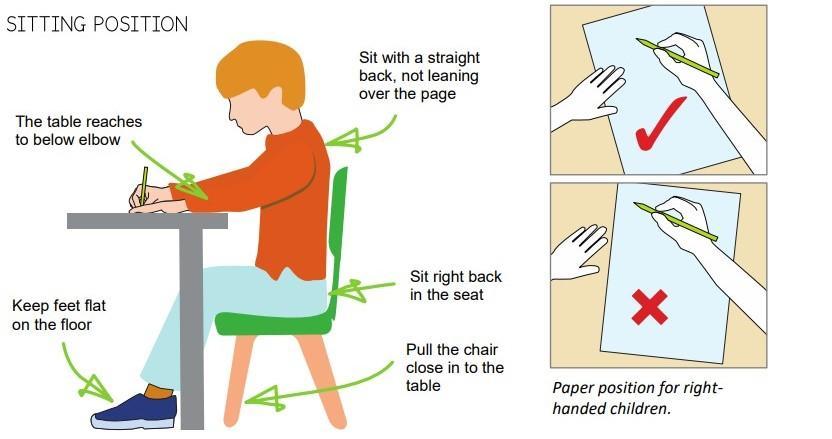
Left-handed children
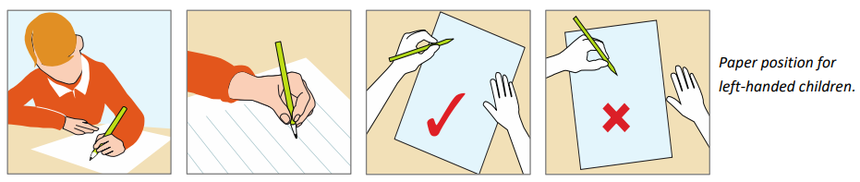
Left-handed children may find it difficult to follow the movements of right-handed teachers as they model letter formation (and vice versa). Teachers should demonstrate to left-handers on an individual or group basis.
- Left-handed pupils should sit to the left of a right-handed child so that they are not competing for space.
- Pupils should position the paper/book to their left side and slanted, as shown.
- Pencils should not be held too close to the point as this can interrupt pupils’ line of vision.
- Extra practice with left-to-right exercises may be necessary before pupils write left-to-right automatically.
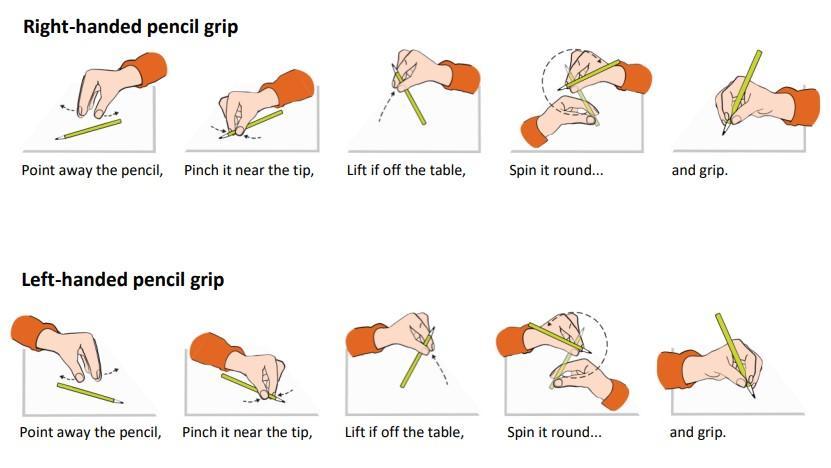
The Tripod Pencil Grip
Both right and left handed children should be encouraged to use the tripod grip which allows the pen/pencil to be held securely whilst allowing controlled movements of the pen/pencil nib. We use the Tripod Grip Rhyme:
There are no items in this Multi Image Block